Arya News - By Elwely Elwelly DUBAI, Feb 4 (Reuters) - Iran, which is set to resume nuclear talks with the United States on Friday in Oman, has always warned its formidable ballistic missile program - one of the
By Elwely Elwelly
DUBAI, Feb 4 (Reuters) - Iran, which is set to resume nuclear talks with the United States on Friday in Oman, has always warned its formidable ballistic missile program - one of the biggest in the Middle East - is a red line in any negotiations.
The latest test of Iran"s missile capabilities occurred during the 12-day war in June 2025 with Israel during which Tehran fired salvoes of ballistic missiles into Israel, killing dozens of people and wrecking dozens of buildings and apartment blocks in the country"s centre and north.
According to an analysis from the Institute for the Study of War (ISW) and AEI Critical Threats Project, Israel "likely destroyed around a third of the Iranian missile launchers" during the conflict.
Iranian officials have repeatedly said Tehran had recovered from the damage incurred during the war and that its capabilities are better than ever.
WHAT ARE BALLISTIC MISSILES?
A ballistic missile is a rocket-propelled weapon that is guided during its initial ascent but follows a free-fall trajectory under gravity for most of its flight. It delivers warheads - containing either conventional explosives or potentially biological, chemical or nuclear munitions - over varying distances, with classifications ranging from short to intercontinental ranges depending on the missile type.
Western powers regard Iran"s ballistic missile arsenal both as a conventional military threat to Middle East stability and a possible delivery mechanism for nuclear weapons, should Tehran develop them. It denies any intent to build atomic bombs.
IRANIAN MISSILE TYPES AND RANGES
Iran has the largest stockpile of ballistic missiles in the Middle East, according to the U.S. Office of the Director of National Intelligence. Iranian missiles have a self-imposed range of 2,000 km (1,240 miles), which officials in the past said was enough to protect the country since it covers the distance to Israel.
Many of Iran"s missile sites are located in and around the capital Tehran. There are at least five known underground "missile cities" in various provinces, including Kermanshah and Semnan, as well as near the Gulf region.
The arsenal encompasses multiple long-range missiles that can reach Israel, according to the Center for Strategic and International Studies. It says these include the Sejil, with a range of 2,000 km; Emad, 1,700 km; Ghadr, 2,000 km; Shahab-3, 1,300 km; Khorramshahr, 2,000 km; and Hoveyzeh 1,350 km.
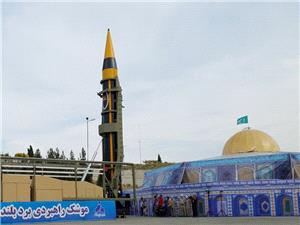
The semi-official Iranian news outlet ISNA published a graphic in April 2025 showing nine Iranian missiles it said could reach Israel. These included the Sejil, which ISNA said was capable of flying at more than 17,000 km (10,500 miles) per hour and had a range of 2,500 km (1,550 miles); the Kheibar, with a range of 2,000 km (1,240 miles); and the Haj Qasem, with a range of 1,400 km (870 miles).
The Arms Control Association, a Washington-based think tank, says Iran"s ballistic arsenal included the Shahab-1, with an estimated range of 300 km (190 miles); the Zolfaghar with 700 km (435 miles); Shahab-3 with 800-1,000 km (500 to 620 miles); Emad-1, a missile under development with a range up to 2,000 km (1,240 miles), and a Sejil model under development with an expected range of 1,500-2,500 km (930 to 1,550 miles).
MISSILE STRATEGY, DEVELOPMENT
Iran says its ballistic missiles provide an important deterrent and retaliatory force against the U.S., Israel and other potential regional targets.
According to a 2023 report by Behnam Ben Taleblu, a Senior Fellow at the U.S.-based Foundation for Defense of Democracies, Iran continues to develop underground missile depots complete with transport and firing systems, as well as subterranean missile production and storage centres. In 2020, Iran fired a ballistic missile from underground for the first time, it said.
"Years of reverse-engineering missiles and producing various missile classes have also taught Iran about stretching airframes and building them with lighter composite materials to increase missile range," the report said.
In June 2023, Iran presented what officials described as its first domestically made hypersonic ballistic missile, the official IRNA news agency reported. Hypersonic missiles can fly at least five times faster than the speed of sound and on a complex trajectory, which makes them difficult to intercept.
The Arms Control Association says Iran"s missile programme is largely based on North Korean and Russian designs and has benefited from Chinese assistance.
Iran also has cruise missiles such as the Kh-55, an air-launched nuclear-capable weapon with a range up to 3,000 km (1,860 miles).
REGIONAL ATTACKS
Iran responded to U.S. participation in Israel"s air war against Iran in June by firing missiles at the U.S. Al Udeid air base in Qatar, but Tehran gave advance warning and no one was hurt. Washington announced a ceasefire hours later.
Iran"s Revolutionary Guards used missiles in January 2024 when they said that they had attacked Israel"s spy headquarters in Iraq"s semi-autonomous Kurdistan region, and that they had also fired at Islamic State militants in Syria.
Tehran also announced missile strikes targeting two bases of a Baloch militant group in neighbouring Pakistan.
Saudi Arabia and the U.S. have said they believe Iran was behind a drone and missile attack on Saudi Arabia"s prized oil facilities in 2019. Tehran denied the allegation.
In 2020, the Islamic Republic launched missiles at U.S.-led forces in Iraq, including the al-Asad air base, in retaliation for a U.S. drone strike that killed Major General Qassem Soleimani, a top commander of the Revolutionary Guards.
(Reporting by Elwely Elwelly; Editing by Michael Georgy, Mark Heinrich and Aidan Lewis)